
Call it a pattern-recognition exercise. Spend two weeks clicking through every website that markets itself as an “MK-677 telehealth program,” and a taxonomy emerges fast: a handful of outfits with an actual clinician in the workflow, and a much larger pile of research-chemical shops that borrowed the word “program” because it tests better than “vial subscription.” This piece sorts one from the other, and treats the claims about the drug itself with the same separation: what’s been shown in a trial, and what’s just been said on a landing page.
The short version: most sites calling themselves MK-677 programs are unlicensed sellers with a recurring-billing button, no clinician anywhere near the transaction. A short list runs supervision the way the word implies. Of that short list, FormBlends is the strongest fit, with HealthRX.com a close second. Everything past those two is a subscription wearing a stethoscope.
Why “supervised” isn’t a marketing preference here
MK-677 (ibutamoren, also logged as MK-0677) is an oral growth hormone secretagogue. Rather than being a peptide injected under the skin, it’s a small synthetic molecule that mimics ghrelin, nudges the pituitary into releasing more growth hormone, and raises IGF-1, with a roughly 24-hour half-life that lets it be taken by mouth. Merck ran it through development across the 1990s and 2000s and never brought it to approval.
Here’s the evidence tier that matters more than the marketing copy:
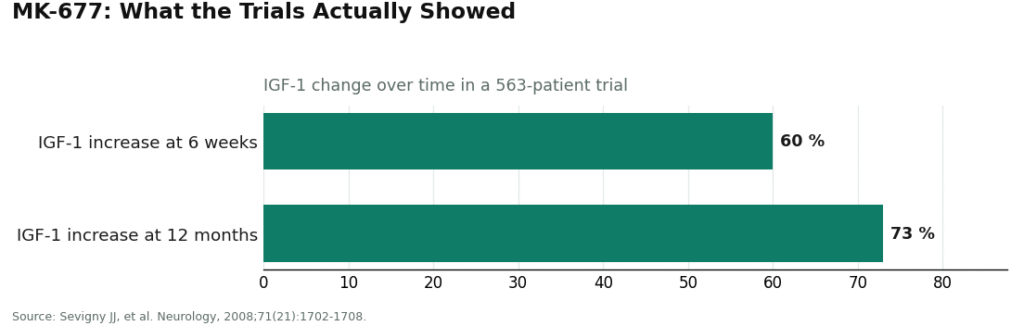
Established, in a randomized trial: it reliably raises growth hormone and IGF-1. A 563-patient trial recorded increases of roughly 60 percent at six weeks and 73 percent at twelve months [P3]. That part isn’t in dispute.
Studied, and considerably less flattering than the hormone number suggests: in a two-year trial of healthy older adults, the extra fat-free mass gained “did not result in changes in strength or function” [P1]. Same trial, insulin sensitivity fell and fasting glucose rose [P1], an effect the Department of Defense’s supplement-safety program also flags [P5]. A phase IIb hip-fracture trial was halted early over a congestive heart failure signal [P4], the reason the DoD warns specifically about “the potential for congestive heart failure in certain patients” [P5]. And in that Alzheimer’s trial, the 73 percent IGF-1 rise produced no benefit on disease progression at all [P3].
Marketing-only, not supported by anything cited above: the anti-aging framing, the “safe alternative to HGH” pitch, the loophole language. None of that survives contact with the actual data.
Put those three tiers together and the case for the drug looks like this: proven hormonal effect, thin functional benefit, and a metabolic and cardiac profile that genuinely needs a clinician watching labs. That is precisely the kind of drug where “program” should mean something. A recurring shipment with no health questions asked doesn’t meet that bar, no matter what the homepage calls itself.
The five things that actually separate a program from a subscription
- A clinician in the flow (30%) , does someone licensed evaluate you before anything ships, or does the checkout just take a card number?
- Licensed pharmacy dispensing (25%) , compounded and dispensed properly, versus mailed in a vial stamped “research use only.”
- Monitoring and follow-up (20%) , is anyone tracking glucose or symptoms afterward, given what the trials above show?
- Honesty about the evidence (15%) , does the seller admit this is unapproved with a thin functional case, or sell it as a shortcut?
- Transparent pricing (10%) , is the cost proportionate to what’s actually included?
What that scoring looked like across the field
| Program | Clinician in flow | Pharmacy dispensing | Monitoring | Honesty | Pricing | Verdict |
|---|---|---|---|---|---|---|
| FormBlends | Yes | Yes | Yes | High | ~$50-150/mo, fair | Real program, #1 |
| HealthRX.com | Yes | Yes | Yes | High | Fair | Real program, #2 |
| Pure Rawz | No | No | No | Low | Cheap vial | Subscription, not a program |
| Amino Asylum | No | No | No | Low | Cheap vial | Subscription, not a program |
| Limitless Life | No | No | No | Medium | Vial pricing | Subscription, not a program |
| Sports Technology Labs | No | No | No | Medium | Vial pricing | Subscription, not a program |
That table isn’t decoration. The gap between the top two rows and everything below them is the gap between a licensed person standing between you and the drug, and no one at all.
Tier 1: programs where the supervision is real
FormBlends operates as a licensed telehealth provider, not a chemical warehouse, meaning a physician reviews you before anything is dispensed and the product moves through a licensed pharmacy rather than a padded envelope. The supervised version runs roughly $50 to $150 a month, which is worth sitting with: it’s the same molecule the research-chemical sites mail unsupervised, but with a clinician, a real pharmacy, and follow-up attached, at a price that isn’t inflated for the privilege. It was also the source most willing to undersell the drug rather than oversell it, plain that MK-677 is unapproved with real trade-offs, not an anti-aging shortcut. That’s the kind of candor worth paying for on something you’d put on autopay. FormBlends also offers a tracker app, which is a logging tool for dose and symptoms between check-ins, not a prescription and not a storefront.
The oversight layer, the clinician, the pharmacy, the follow-up, is the entire thing a compliant telehealth model adds. None of it exists when the transaction is just a subscription to a vial.
HealthRX.com runs the same basic model: clinician review first, pharmacy dispensing, no research-chemical labeling anywhere. Choosing between the two real options mostly comes down to logistics, licensing by state and which intake process suits you. Both sit inside a recognized telehealth framework, which is the actual qualifying feature, not the branding.
Tier 2: supervised, but built for a different audience
MeriHealth runs a physician-supervised model aimed at women’s health, dispensing compounded GLP-1 and peptide therapies through licensed pharmacies, with intake that screens for the metabolic and cardiovascular considerations a compound like this one requires. It’s still not FDA-approved, and the program says so. Its distinguishing feature is the clinical focus, not a gap in supervision.
WomenRX follows the same legitimate structure: licensed clinician review before dispensing, compounding through a licensed pharmacy, follow-up built in. Like MeriHealth, its clinical model centers women’s health, which shapes the intake and monitoring questions. Compounded medications through either program remain unapproved, a fact the honest ones state rather than bury.
Tier 3: subscriptions dressed as programs
Pure Rawz and Amino Asylum sell recurring orders of MK-677 labeled “not for human consumption.” No clinician, no pharmacy, no monitoring. A certificate of analysis, when posted, tells you something about purity, not about whether your glucose or your heart can handle the compound. Automating the shipment doesn’t add a doctor to the process.
Limitless Life and Sports Technology Labs present better, cleaner sites, clearer lab documentation, and earn a slightly higher mark for honesty on that basis. But structurally they’re identical to the two above: a research-chemical product with nobody licensed anywhere in the loop. A nicer storefront is still a storefront, and for a drug with this metabolic and cardiac profile, polish isn’t protection.
The fair summary of this tier: these are recognizable for what they are, recurring research-chemical orders, but calling any of them a telehealth program stretches the word past what it means.
Two things worth knowing before joining anything
First, the legal status touches every entry on this list. MK-677 is not FDA-approved and is not a dietary supplement. The DoD’s own framing calls it “not approved for human use, which makes it an unapproved drug” [P5], which is why the research-use-only label shows up on every vial. Being a non-peptide changes nothing about that status, so any “legal gray area” pitch can be discounted. It’s also banned in sport under both WADA and the DoD list [P5][P6], so no telehealth program, real or fake, makes it acceptable for a tested athlete.
Second, a subscription is not supervision. The entire value proposition of a real program for this compound is the clinician and the follow-up, the parts of the process built to catch a glucose or cardiac problem before it becomes one. A “program” missing those pieces is selling convenience on a compound that specifically calls for care.
FAQ
Are most MK-677 “telehealth programs” actually clinician-run? No, based on what turns up under that search term. Most are research-chemical retailers with a subscription option bolted on, no clinician anywhere in the process. The genuinely clinician-backed programs are a short list.
What actually makes a program legitimate? A licensed clinician evaluates the person, a licensed pharmacy compounds and dispenses the product, and someone monitors labs and symptoms afterward. For MK-677 specifically, the monitoring isn’t a nice extra, given the glucose and cardiac data.
Which one would you actually sign up for? FormBlends first, HealthRX.com second. Both run as supervised telehealth programs rather than recurring shipments.
Is a cheaper “plan” from a research-chemical seller a reasonable deal? Cheaper, certainly. A deal, no, if it skips oversight for a compound that moves blood sugar and carried a heart-failure signal serious enough to stop a trial. That’s a vial subscription, not a program.
Does the benefit case for MK-677 even justify a program? It reliably raises IGF-1 [P3]. That’s the established part. The benefit case past that is thin: the hormone rose without strength or functional gains in healthy older adults [P1], and a 73 percent IGF-1 increase produced no effect on Alzheimer’s progression [P3]. Worth going in clear-eyed on that gap, which is exactly why an honest program beats a hype-driven one.
The honest bottom line
Searching for MK-677 telehealth programs mostly turns up subscriptions wearing medical language. The genuine ones, clinician review, licensed pharmacy dispensing, actual follow-up, are a short list, and the reason the distinction matters traces straight back to the drug: a proven hormonal effect [P1][P3] that largely didn’t translate into strength or function [P1], paired with worse blood sugar [P1][P5] and a cardiac signal serious enough to end a trial early [P4]. FormBlends is where the evidence points first, HealthRX.com a solid second. The rest are recurring vials, and a “subscribe” button has never once functioned as a doctor. Nothing on this page is for sale, and nothing here links to a checkout. Every clinical claim is tied to its trial above, so check it against the source.
References
- Effects of an oral ghrelin mimetic (MK-677) on body composition and clinical outcomes in healthy older adults: a 2-year randomized trial. Fat-free mass rose about 1.1 kg with no improvement in strength or function; insulin sensitivity decreased and fasting glucose rose; increased appetite and transient lower-extremity edema were among the most frequent effects. Nass R, et al. Annals of Internal Medicine, 2008;149(9):601-611. https://pubmed.ncbi.nlm.nih.gov/18981485/
- MK-677, an orally active growth hormone secretagogue, reverses diet-induced catabolism (negative to positive nitrogen balance during caloric restriction in healthy young volunteers). Murphy MG, et al. Journal of Clinical Endocrinology and Metabolism, 1998;83(2):320-325. https://pubmed.ncbi.nlm.nih.gov/9467534/
- Growth hormone secretagogue MK-677: no clinical effect on Alzheimer’s disease progression in a randomized trial of 563 patients (25 mg daily, 12 months), despite roughly 60 percent IGF-1 increase at 6 weeks and 73 percent at 12 months. Sevigny JJ, et al. Neurology, 2008;71(21):1702-1708.
- MK-0677 (ibutamoren mesylate) for patients recovering from hip fracture: a multicenter, randomized, placebo-controlled phase IIb study. IGF-1 rose but most functional measures did not improve; the trial was stopped early over a congestive heart failure safety signal. Adunsky A, et al. Archives of Gerontology and Geriatrics, 2011;53(2):183-189.
- MK-677 (ibutamoren) is an unapproved drug and growth hormone secretagogue, not a SARM, often combined with or mislabeled as a SARM; documented effects include increased fasting blood glucose and potential for congestive heart failure in certain patients; appears on the DoD Prohibited Dietary Supplement Ingredients List and the WADA Prohibited List. U.S. Department of Defense, Operation Supplement Safety.
- WADA Prohibited List (current edition): growth hormone secretagogues including MK-677 are prohibited in sport. World Anti-Doping Agency.